Scopa at a glance
- Players
- 2 (also 3, or 4 in pairs)
- Deck
- 40 Italian cards
- Cards
- 3 in hand, 4 on the table
- Play to
- 11 points
Scopa is one of Italy's most popular card games and has been played there since at least the 18th century. The idea is simple: the card you play captures a card of the same value from the table, or several cards that add up to that value. Take everything and you have scored a scopa, Italian for “broom”, because you have swept the table. At the end of the round points are awarded for cards, Coins, the settebello, the primiera and each scopa.
This page explains classic two-player Scopa, with the same rules you will find in Scopa AI.
The deck
Scopa is played with an Italian deck of 40 cards in four suits: Coins (denari), Cups (coppe), Swords (spade) and Clubs (bastoni). Each suit has ten cards: Ace to seven, plus three face cards.
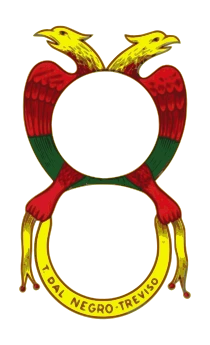 Coins
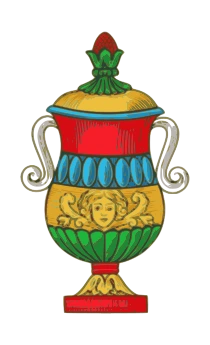 Cups
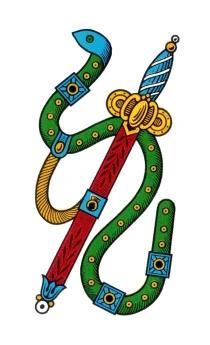 Swords
 Clubs
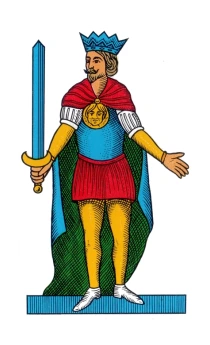
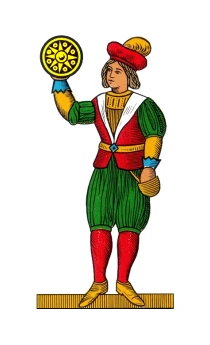 Knave 8
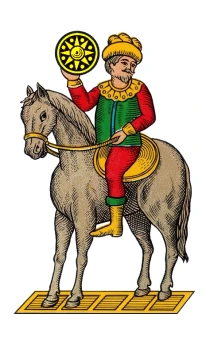 Knight 9
 King 10
For captures only the value of a card matters, not its suit: an Ace counts 1, the cards from two to seven count their number, the Knave (fante) 8, the Knight (cavallo) 9 and the King (re) 10.
Regional decks such as the Neapolitan, Piacentine, Sicilian and Sardinian cards differ in their artwork, not in the rules. No Italian deck at hand? Take a standard 52-card deck and remove the eights, nines and tens: the Jack then counts 8, the Queen 9 and the King 10.
The deal
The dealer shuffles, gives three cards to each player and turns four face up in the middle of the table. The dealer's opponent plays first, and the players then take turns, one card at a time.
When both players have played their three cards, the dealer gives out three more each, without adding any to the table. With two players there are six deals in all: after the last one the deck is used up, and once those cards have been played too, the round is over. In the next round the other player deals.
If three or four Kings are among the four cards turned up at the start, the cards are shuffled and dealt again: those Kings could no longer all be captured, and nobody could score a scopa for the whole round.
Your turn: capture or place
On your turn you play one card from your hand. One of two things happens.
- You capture. If a card of the same value is on the table, you take it. If there is none, you may take several cards whose values add up to that of your card: a 7 takes a 4 and a 3; a King, which counts 10, takes a 6, a 3 and an Ace. The card you played and the cards you took go face down onto your pile.
- You place. If your card cannot capture anything, it stays face up on the table, where either player can take it later.
Three rules to remember:
- Capturing is mandatory. If the card you play can capture, it must: you cannot leave it on the table. You are still free to choose which card to play.
- A matching card comes before a sum. If a card of the same value as yours is on the table, you must take that card, not a combination.
- If more than one capture is possible, you choose. With a 7, if a 5, a 2, a 4 and a 3 are on the table, you may take 5 + 2 or 4 + 3, not all four. The same goes for two cards that match yours: you take only one.
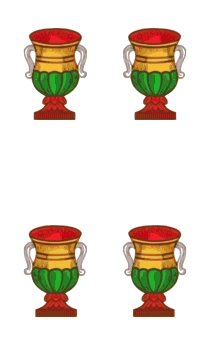

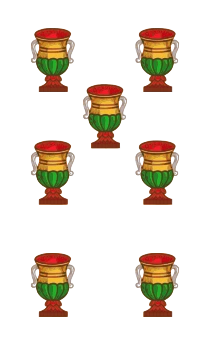
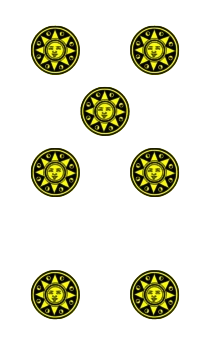
You must take the seven of Cups. 4 + 3 also makes 7, but the matching card comes first.
The scopa
You score a scopa, a sweep, when one capture takes every card off the table. It is worth one point, added to the points counted at the end of the round. To mark it, players usually put one card face up and sideways in their pile.
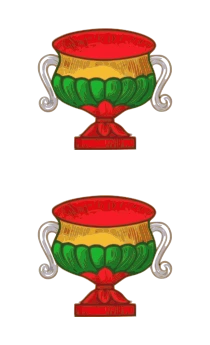
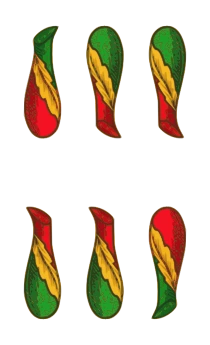
The Knave counts 8, and 2 + 6 makes 8: you take both cards and the table is empty. Scopa!
After a scopa the table is empty, so the opponent can only place a card.
There is one exception: the last play of the round never counts as a scopa, even if it clears the table.
The end of the round
The round ends when the deck is used up and every card has been played. The cards left on the table go to whoever made the last capture, and they do not count as a scopa. Each player then looks through their pile, and the points are awarded.
Scoring
Every round has four fixed points to win, plus one for each scopa.
| Point | Worth | Who gets it |
|---|---|---|
| Cards (carte) | 1 | The player who captured more cards: at least 21 of the 40. |
| Coins (denari) | 1 | The player who captured more cards of the Coins suit: at least 6 of the 10. |
| Settebello | 1 | The player who captured the seven of Coins. |
| Primiera | 1 | The player with the better primiera. |
| Scopas (scope) | 1 each | The player who scored them. |
If a point is tied, that is 20 cards each, 5 Coins each or the same primiera, nobody gets it. The settebello is always awarded.
Primiera in two lines
For each suit, take the best card you captured and add up the primiera values: a seven is worth 21, a six 18, an Ace 16, a five 15, a four 14, a three 13, a two 12 and a face card 10. The higher total takes the point; to compete you need at least one card of every suit. Values, worked examples and special cases are in the guide to the primiera.
A scoring example
Giulia and Marco have just finished a round. This is what their piles hold.
| Point | Giulia | Marco | Goes to |
|---|---|---|---|
| Cards | 22 | 18 | Giulia |
| Coins | 4 | 6 | Marco |
| Settebello | yes | no | Giulia |
| Primiera | 76 | 78 | Marco |
| Scopas | 1 | 0 | Giulia |
| Points this round | 3 | 2 |
Giulia has the settebello, but the primiera goes to Marco: he has two sevens and two sixes (21 + 21 + 18 + 18 = 78), she has two sevens, a six and an Ace (21 + 21 + 18 + 16 = 76).
Winning the game
The points from each round are added up. The winner is the player who has reached the target at the end of a round: usually 11 points, though games are also played to 16 or 21. If both players get there in the same round, the one with more points wins.
If they are level, another round is played, until one of them pulls ahead: a game of Scopa never ends in a draw.
Tips for beginners
- Watch what you leave on the table. If a single card is left, or several cards that add up to no more than 10, the opponent needs only the right card to score a scopa.
- Keep an eye on the sevens. In the primiera they weigh more than any other card, and the seven of Coins is worth a point on its own.
- Count the Coins. There are ten: with six, the point is yours.
- Remember the cards that have gone. Each value appears four times in the deck: knowing which cards have already been captured tells you what the opponent can still take.
Variants
In Italy Scopa is played in many ways. These are the best-known variants; none of them is in the app, which follows the classic rules described above.
- Four players. Two pairs play against each other, usually to 21 points.
- Scopone. Four players in pairs: nine cards each and four on the table, or ten each and none on the table.
- Asso pigliatutto. Playing an Ace takes every card on the table.
- Napola. Capturing the Ace, two and three of Coins earns three points, plus one for each further card of Coins in sequence.
- Re bello. The King of Coins is worth a point as well.
- Scopa a quindici. You capture when the card you play and the cards you take add up to 15.
Frequently asked questions
How many cards are dealt in Scopa?
Three each, plus four face up on the table at the start of the round. When the three cards have been played, three more are dealt, until the deck runs out.
Do you have to capture?
Yes, if the card you play can capture. You do not have to play that particular card, though: you can choose another one from your hand.
What is the settebello worth?
One point, for the player who captures the seven of Coins. The same card also counts among the cards, among the Coins and in the primiera, where it is worth 21 like the other sevens.
What are the Knave, Knight and King worth?
For captures, 8, 9 and 10. In the primiera they are worth 10 each.
Does the last capture count as a scopa?
No. The last play of the round never counts as a scopa, and the cards left on the table go to whoever captured last.
How many points do you need to win?
Usually 11. Games are also played to 16 or 21: in Scopa AI you choose the target.
What happens in a tie?
If one of the fixed points is tied, nobody gets it. If the game score is tied, another round is played.
Can I play Scopa online for free?
Yes. With Scopa AI you play in your browser against the computer, against an AI model or against a friend, with no sign-up. There is also an app for iPhone, iPad and Android.